2008年3月16日

《财富》专访史蒂夫·乔布斯


Sent to you by hao via Google Reader:


via apple4us by flypig on 3/15/08

Most admired trouble


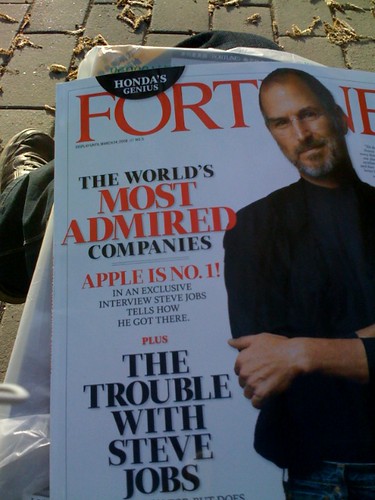
下午去建国门,路过友谊商店,在外刊区闲逛,碰巧看到这本传说中的《Fortune》。因为此前张亮同学将那篇关于苹果的"最受推崇企业"稿件斥为"陈词滥调",本打算略过不买。

结果鬼使神差地,又拣出来翻了翻,看见内文大标题下方有排大字:"史蒂夫·乔布斯专访。"大惊失色,于是花 40 大洋买下,坐在日坛公园里一口气看完,觉得大受启发。

出于对张亮同学险些误导读者的出离愤怒,我决定将这篇专访全文翻译。当然,在即将上摊的中文版《财富》里,你将可以看到"官方"的译本。(他们当时翻译的"好学若饥、谦卑若愚"确实不错。)


===

史蒂夫·乔布斯谈苹果效应 (Steve Jobs on Apple's Chemistry)

(原文链接在此。)

今年2月,《财富》高级编辑贝齐·莫里斯 (Betsy Morris) 在夏威夷的柯纳镇 (Kona, Hawaii) 采访了乔布斯。当时他正在那里与家人一起度假。访谈内容涉及了苹果的成功之道、发展障碍以及没有史蒂夫·乔布斯的苹果将会何去何从。

关于 iPhone 的起源 我们都用过手机,体验总是极其恐怖。软件烂得一塌糊涂,硬件也不怎么样。我们和朋友聊过,他们也都非常痛恨自己的手机。于是我们觉得,这些东西完全可以变得更加强大。这是一个巨大的市场--我的意思是,每年有10亿部手机被卖掉,这单生意在数量上可比随身听庞大多了,这相当于每年个人电脑出货量的四倍。

这是个巨大的挑战--我们要做出一款可以让我们自己一见钟情的手机。从未有人想过往手机里放进一个如 OS X 般复杂的操作系统,看来这确实是个问题。在公司内部,针对我们能否实现这一目标曾经有过大规模的争论。我不得不当机立断地做出决定:"我们可以做到的。让我们试试看吧。"那些最聪明的软件工程师说,他们可以做得到,而我们必须给他们这个机会。他们果然做到了。

关于苹果和消费者之间的联系 这事儿和流行文化无关,和坑蒙拐骗无关,和说服人们接受一件他们压根儿不需要的东西也无关。我们只是在搞明白我们自己需要什么。而且我认为,我们已经建立了一套良好的思维体系,以确保其他许多人都会需要这么个东西。我们收了钱就是来做这事儿的。

关于战略选择 我们从不做市场调研,我们只是想做出伟大的产品。我们之所以开发 iTunes 音乐商店,是因为我们觉得,能够以电子方式购买音乐会相当了不起,而不是因为我们计划去重新定义音乐产业。我的意思是,音乐发行逐步电子化的趋势简直已经白底黑字地写在那儿了。如果你可以简单地通过电子进行传播,为什么还要多花那些冤枉钱呢?

关于苹果的关注点 人们以为"关注"的意思就是对你必须关注的事情点头称是。这并不是"关注"的全部内涵。"关注"意味着必须对另外 100 个好点子说不。你必须谨小慎微地做出选择。对于那些我们做了的事情和那些我们没有做的事情,我都同样引以为傲。这里有一个再贴切不过的例子:很多年以来,我们都迫切地需要做出一款 PDA 产品,而终于有天我意识到,90% 的 PDA 用户只是在路上把信息从里头调出来而已。他们不会把信息放进去。没过多久,手机就实现了这样的功能,于是 PDA 市场就萎缩到了今天的规模。所以我们决定不进入这个领域。如果我们选择了跟进,我们就没有资源去开发 iPod 了。

关于苹果如何激励员工 人这辈子没法做太多事情,所以每一件都要做到精彩绝伦。因为,这就是我们的宿命。人生苦短,你明白吗?所以这是我们为人生做出的选择。我们本可以在日本某地的某座寺庙里打坐,我们本可以扬帆远航,管理层本可以去打高尔夫,他们本可以去掌管其他公司,而我们全都选择了在这辈子来做这样的一件事情。所以这件事情最好能够他妈做得更好一点。

关于为什么人们选择在苹果工作 因为你在其他任何地方都做不了你在苹果可以做的事情。在那些电脑公司里,工程学早就没影儿了。在消费类电子产品公司里,他们根本不了解软件层面的事情。所以你现在根本不可能在其他地方做出你能在苹果公司里做出来的产品。苹果是唯一一家将方方面面全盘掌控的公司。没有其他公司能够造一台 MacBook Air 出来,因为我们不仅控制了硬件,我们还控制了操作系统。得益于操作系统和硬件之间的紧密互动,我们才可以实现目标。在 Windows 和戴尔笔记本之间就没有什么紧密互动可言。

关于苹果能否没有他 苹果公司人才辈出。我把蒂姆·库克 (Tim Cook) 提拔成了 COO 并将 Mac 部门交到了他手上,他确实成绩斐然。我的意思是,有人说:"哦,老天,如果(乔布斯)被公交车给碾死了,苹果就歇菜了。"不过,你知道嘛,虽然这不是什么值得高兴的事儿,但董事会肯定会为 CEO 这个位置列出一些不错的人选。我的任务就是将整个管理团队都培养成优秀的继任者,我确实在尝试这么做。

关于他苛刻的名声 我的工作不是对人表现得和蔼可亲。我的工作就是把我们手下这些牛人们召集起来然后督促他们然后让他们做得好上加好。怎么做呢?那就是采取更为极端的思路。

关于排除万难 你总会遇到一些看似山穷水尽的局面。拿 iPhone 举例。我们曾经有过一个迥异的 iPhone 封装设计,那时候离面世已经为时不远,甚至没有时间再做改动了。在某个周一的早晨,我走进公司说:"我就是不喜欢这个东西。我无法说服我自己爱上这个玩意儿。而这是我们做过的最重要的产品。"然后我们就按下了重启键。我们重新回顾了曾经做出来的无数款模型机以及曾经有过的想法。最终,我们做出来了今天你看到的 iPhone。相比之下,好得出人意料。那个过程简直是去地狱里走了一圈,因为你不得不当着整个团队的面说:"你们在过去一年里做出来的所有东西,我们都要全盘否定并且重头再来。而且我们必须加倍努力,因为我们已经没时间了。"而你知道每个人都说了什么吗?"算我一个。"这种情况发生得比你想象的频繁得多,因为这不仅仅是工程学和科学。这也是艺术。有时候当你身处这种危机之中,你无法确定自己是否可以把整件事情推向终点。但我们总是能够到达彼岸。所以我们总是胸有成竹,虽然有时候你会心生疑虑。

关于他的管理风格
 在苹果公司,我们有 25,000 人。差不多 10,000 人在专卖店里工作。而我的工作是和最顶端的大约 100 个人协作,这就是我的工作内容。这并不意味着他们都是副总裁之类的领导,他们中的一些人只是贡献卓著的关键个体。所以如果有好点子出现,我的一部分工作就是把它传播开来,问问各人的看法,让人们围绕着它展开讨论,就此争论不休,让想法在这个由 100 人组成的群体里充分循环。

关于他马拉松似的周一例会 当你招到了真正的人才,你就必须让他们分担一部分生意,并且充分放权。当然这并不意味着我就不能发表意见了。可是你招他们进来就是为了把接力棒交到他们手里。我希望他们能够做到青出于蓝而胜于蓝。所以要实现这个目标,就必须让他们了解所有事情,而不是停留于自身的业务范围之内。所以我们每周一做的事情就是回顾整个公司的运营情况。我们着眼于之前一周的销售项目,我们着眼于每个正在开发的产品--以及我们那些麻烦缠身的产品,那些需求超出了我们能力范围的产品。所有正在开发中的产品,我们都会回顾。我们每周都做这件事情。在苹果公司,我们没有太多的繁文缛节,但这是为数不多必须雷打不动的惯例之一。

关于寻找人才 如果要招一个级别够高的员工,那么此人能否胜任就像是在赌博。他们必须智商够高。但对我来说,问题则在于:他们是否会爱上苹果?因为如果他们能够与苹果坠入爱河,那么其他所有事情就会迎刃而解。他们会以苹果的最大利益为工作的出发点,而不是出于个人利益、史蒂夫的利益或者其他某个人的利益。

招聘绝非易事,就像是大海捞针一般。我这辈子经手过的招聘人数大概在 5,000 以上。我对待此事的态度非常严肃。你无法在一个小时的面试里了解足够多的信息。所以在最后,你只能凭借直觉做出选择。我对这个人印象如何?他们在面对挑战时会如何反应?他们现在为什么会来到这里?我问所有人:"你为什么来这里?"答案本身并不是你想要的东西。这只是元数据。

关于 iPod 的引爆点 有段时间我们过得很艰难。Mac 因为各种各样的原因不为众人所接受,这些人选择了 Windows。即便我们全力以赴,市场份额却没有增长。有时候,这会让你怀疑自己是否满盘皆错。或许我们的东西不够好,即便我们相信它已经达标。或许人们对此根本就漠不关心,这会让人心情更糟。

iPod 的出现让我们突破了操作系统的玻璃天花板。事情的美妙之处在于,它证明了苹果式的创新、苹果式的工程学以及苹果式的设计都是至关重要的。iPod 占据了 70% 的市场份额。即便是在多年打拼并见证了 Mac 电脑 4% 至 5% 的市场份额之后,我仍然无法用语言形容 iPod 对于苹果来说有多么重要。它对于所有人来说,都是一剂药效惊人的强心针。

关于他们之后的作为 我们干劲倍增,并且更加努力。我们曾经说过:"这事儿挺不错,让我们搞得更大点。"我的意思是,Mac 的市场份额在每个季度都有增长。我们的增长速度是整个行业的四倍。而且我们正保持着这个势头。我们把英特尔处理器放了进来,而且我们不仅可以跑 Mac 软件,还可以运行 PC 上的应用程序。我认为这件事情最重要的一点在于,人们终于意识到,他们没必要再忍 Windows 了--其实还有另一个选择。我认为在此之前,从来没人这样想过。

关于赶上下一波技术热潮 事情的发展速度其实十分缓慢,这你也知道的。确实如此。这些一波接一波的技术热潮,你早在它们发生之前就能够预见到了。你需要做的,只是精明地选择站上哪一波热潮的风口浪尖。如果你站错队,那么你就会浪费许多精力。但是如果你走对方向,它呈现魅力的速度也是相当之缓慢。这也许要耗费数年之久。多年前,我们最具前瞻性的观点之一,就是不要涉足任何我们不具备核心技术的领域,这样你会被杀得片甲不留。我们意识到,对于绝大多数未来的消费类电子产品而言,软件都将是核心技术。而我们在软件领域实在是得心应手。我们会做操作系统;我们会做 iTunes 这样能够同时在 PC 和 Mac 上运行的程序;我们会做嵌于设备内部的程序,让你放进 iPod 和 iPhone 里面;我们还会做运行于悄无声息之中的后端软件,比如 iTunes。我们可以编写各种各样的软件,让它们交织在一起并无缝地协同工作。现在你问问你自己,还有哪些其他公司可以做这件事情?肯定寥寥无几。

关于失败,目前为止,关于 Apple TV 的失败 说说我的看法。每个人都曾经尝试过为客厅开发一个了不起的产品。微软试过了,我们也试过了--每个人都试过了。并且,每个人都失败了。而且这就是为什么我将其称作一项"爱好"。它还不可以称作一个生意,它只是一个爱好。我们已经做出了第二次尝试--"Apple TV, Take 2"是我们在公司内部对它的称呼。我们意识到,我们做出来的第一款产品只是在帮助你从电脑上取得内容,并且通过无线网络发送到 Apple TV 上面。嗯,事实证明这并不是人们想要的体验。我的意思是,没错,能在大屏幕上看到你的照片也不错--但那是蛋糕上面的霜糖,而不是蛋糕。事实证明,人们真正需要的,是电影。所以我们开始和好莱坞片商进行对话,并且成功地取得了所有好莱坞大片商的租赁授权。现在 iTunes 里面只能找到大约 600 部电影,但是在今年晚些时候,我们就会拥有数以千计的选择。这会不会引发你的共鸣,并且成为你愿意与之共度余生的钟情之物?我们等着瞧吧。我觉得八九不离十。

关于经济衰退期的管理 我们之前已经经历过了一次,就是在 dot-com 泡沫破灭的时候。我告诉公司的是,我们会在经济衰退期里继续坚持自己的投资思路。既然我们曾经花费了巨大的精力将他们招进苹果,我们就不会裁员。我们不到迫不得已,绝不会裁员。而且我们还将持续拨款。实际上,我们当时计划调高研发预算,这样在度过经济衰退期之后,我们才可以领先于竞争对手。我们确实这样做了,而且行之有效。这次,我们还会做出一样的事情。


Things you can do from here:


2008年3月12日

正在阅读:《Astrid & Veronika》


Sent to you by hao via Google Reader:


《Astrid & Veronika》如果拍成了电影,一定是欧洲的大闷片。

这个故事很清淡,Veronika是一名新西兰的文艺女青年,在某个冬天独自来到瑞典,一方面为了找一个安静的地方忘却一些记忆,另一方面完成小说创作。她租下了被村里人成为巫婆的孤老太Astrid的房子。慢慢地,两人有了接触,有了友谊,双方都向对方说出了内心的秘密,两个人的一生被永远改变了……

《The Memory Keeper's Daughter》的作者Kim Edwards如此评价这本小说:"Evokes, with great beauty and precision, the landscape of a friendship."一字不多,一字不少,精炼地概括了这本小说所有的特点。

《Astrid & Veronika》是新西兰作家Linda Olsson的第一本小说。与故事同样清淡的,还有她的文字。当小说中的女主人公Veronika刚来到这个冬雪中安静的小村落时,作者是这么描写的:"The sounds of darkenss were faint but familar. She could hear the snow adjusting to the slowly rising temperature..."对于融雪,我没有见过比这个更美、更独特的描述,一副"great beauty"的意象在Linda Olsson简单却另辟蹊径的用词中呈现了出来。我看到用在这里的"adjusting",产生了一种充满绝望的妒忌。

在这趟旅行开始的时候,Linda Olsson描绘了Veronika的旅行心境:"It had been a slow journey, but it had given her time to think.(这是一趟漫长的旅行,但却让她有时间去想一些问题。)"这句话人人都会说,但Linda Olsson在这句话之后又出人意料地补上一句:"Or erase thoughts.(或者,让她把一些牵挂放下。)"看得出,Linda Olsson是一个对文字表达异常、异常敏感的人,这种敏感还体现在她对环境、对一些小动作细致入微地刻画,比如"i would watch the river flow so eagerly on its way...""When there was a moment of comfortable silence, the music expanded to fill the space""She closed her eyes, took a sip and let the sweetness fill her mouth""She lifted her eyes and looked out the window. She felt as if she were suspended between two worlds, belonging to neigther"……

在新西兰,有许多书评家说Linda Olsson的文字非常的"斯堪地纳维亚"。的确,小说安静得就像北欧的风景。英文并不是Olsson的母语,她是瑞典人。在斯德哥尔摩大学拿到法律学士学位后,从事金融方面的工作。1986年起,她先后居住在肯尼亚、新加坡、英国和日本,在伦敦期间,她进行了创作方面培训,后来移民到新西兰,开始写短篇小说。她似乎对用英文写作比对瑞典语写作更有信心,她说,她的英文写作更为成熟。在这本小说翻译成瑞典文的时候,她曾经尝试亲自操刀,但很快就放弃了,改由他人翻译,她发现自己在瑞典语里面找不到许多英语的对应表达。

人与人之间的关系、安静,都是Olsson感兴趣的。"安静"在《Astrid & Veronika》一书中,呈现出不同的颜色和姿态。至于下一部小说,Olsson将以男性为主人公,她说自己为此正在研究波兰的历史;那部小说很有可能叫《The Consequence of Silence》。...


Things you can do from here:


2008年3月11日

Bloglines - 奥本海默的博士论文和梵高的画


http://blog.sohu.com 破万卷书
卡夫卡说——我们比较容易从生活中制造许多许多书,而从书里则引不出多少生活

奥本海默的博士论文和梵高的画

By 破万卷书

很早以前就听过一个故事,说二战的时候,美国空军轮番轰炸德国的主要城市,唯独留下海德堡不炸,因为早年间,他们都看过一部好莱坞的电影,讲的是一对大学生在海德堡恋爱的故事,这个电影给美国年轻人留下深刻的印象,等他们参军打战,轰炸德国,就对这座美丽的小城手下留情。我从来没考证过这故事的真假,但在去海德堡的火车上,我还是把这个烂故事讲给同伴听。其实,我心里想的是黑格尔,他曾经在海德堡大学任教。

我们在海德堡只有几小时的逗留时间,在内卡河边吃了顿中饭,放弃了河对岸那条著名的"哲学家小道",改去爬古堡,去寻找海德堡大学的学生禁闭处,走马观花的转了一圈,又坐火车回到卡塞尔。过了两天,我又一个人坐火车去了哥廷根。之所以去哥廷根,就是因为哥廷根大学,更确切的说,因为奥本海默。关于奥本海默的求学经历,完全可以出一本"哈佛男孩"式的畅销书,据说,这个犹太家庭"总使人觉得有点感伤,带有一种忧郁的情调",但在这样的家庭里长大,奥本海默的中学毕业成绩非常优秀,他先进哈佛大学的化学系,然后去剑桥卡文迪许实验室读物理,然后去哥廷根大学深造,最终在这里拿到博士学位。

在哥廷根下了火车,租了辆自行车,只5分钟就骑到了哥廷根大学,坐在学校的小广场上,我就开始冥想,他怎么能写出《分子的量子理论》呢?他这个论文到底是什么意思呢?后来爆炸的那两颗原子弹,最早就应该诞生在这所学校附近一个小房间里,诞生在神童奥本海默的稿纸上。这样想了半小时,抽了两支烟,就到老城里转悠,在一家炸鸡店里吃中饭,结果碰到一位中国同胞,他到这里陪女儿念书,女儿是学教育的。我不免暗暗可惜,到这里怎么也应该学学物理呀。

如果时间足够,我兴许还会去耶拿看看耶拿大学。这不是考察德国的大学,还是为了追星,既然我没能在海德堡的"哲学家"小道上冥想黑格尔都思考了什么,那不如到耶拿看看。两百年前,确切的说,1806年秋天,拿破仑的军队打到了耶拿附近,学校里能看见法国侦察兵,法国兵在咖啡馆里聊天,谈论他们的新口号"自由平等博爱",战争进行之际,一位年轻教员——黑格尔先生却完全沉浸在自己的工作中,他在写一本书,名叫《精神现象学》。一个美国作家在他的简明哲学导论里讲述了黑格尔的这段故事,他说,我们的生活被描述为"荒谬的"、"无意义的",我们不时会被那些所谓的"消遣"和"娱乐"活动分神,整个国家失去的是思考的快乐、理解的挑战、灵感以及哲学的慰籍。

大概就是害怕这样的庸常,我才努力,按照黑格尔所说的,要让自己的个人意识到达绝对知识,尽管我对这些名词的理解实在不得要领错误可笑,但我一定要在哥廷根大学操场上冥想一会儿奥本海默。不仅如此,我即将开始一次瑞士之旅,我打算去伯尔尼克拉姆大街49号看看,爱因斯坦自己说过,狭义相对论诞生在伯尔尼克拉姆大街49号。我要到那里去想想什么叫狭义相对论。

哲学家、科学家都难以通过浮皮潦草的旅行来理解,但画家好一点。画家更直观。2004年9月,我在一对朋友的带领下来到巴黎郊外的奥维,车子停在村口,刚走了两步,就看见"奥维的教堂",我头一天刚在奥塞博物馆里看见这幅画的原作,又看到这座真正的物理意义上的教堂,还有教堂前树立着那幅"奥维的教堂",刹那间,这几重形象在我脑子里叠加到一起,不知道哪个更真实。

梵高和他的弟弟就葬在村外的公墓里,墓碑之前是一丛绿色的植物。小村子周围有几十个"景点",都是梵高写生的地方,与画作同一视角的地方都树立着他在这里画的画,你可以把眼前所见与画家笔下的景色相对照。百余年来,几乎没什么变化。梵高自杀的那间小客栈的房子至今还保持着原貌。他活了37岁,那间房子是他一生中住过的第38间房子,在他死之后就没人再居住过。墙壁上有"梵高之友"的一个告示,上面说,如果大家捐款给"梵高之友"协会,那我们就可以在这里挂上一张梵高的真迹。

最先是一个美国人写的传记《渴望生活》让我先认识了这个贫穷潦倒、生活能力差、一事无成的画家,并想当然的把创造性的生活和世俗的幸福生活对立起来。但后来我会逐渐明白一个道理,这个道理还是爱因斯坦说得最为明白:"引导人们通向艺术和科学的最强烈动机之一是摆脱日常生活及其中令人痛苦的粗糙状态和无望的枯燥乏味,摆脱一个人自身总是在变化着的欲望的羁绊。就像画家、诗人或者哲学家一样,科学家努力要创造一个属于他自己的世界。他们中的每个人都使这个宇宙及它的结构成为他的感情生活的支点,这是为了以这种方法去寻找到他在狭窄的个人经历的漩涡中无法找到的宁静与安全。"


2008年3月10日

张一帆:向艾利-布罗德去借艺术品


Sent to you by hao via Google Reader:


不知道以前向大家介绍过没有,每个月都看Art In America或者是Art Forum固然长见识,可是如果你只想每周听听艺术圈子里的琐事或者是想了解洛杉矶哪家画廊最火,一个好的线人是Edward Goldman。听他的广播有几年了,直到他去年底告诉听众自己从来没有去过荷兰和中国,并且发疯一样的在荷兰一天看三个美术馆时,他在我心中才一下活灵活现起来。作为批评家,能够像小孩子一样绘声绘色的描述林布兰的名画,多么理所当然而又少见的现象。

这个礼拜就又从他口中听来一个消息,不知道国内会不会有美术馆去试一试。美国当代艺术的大搜藏家艾利-布罗德(Eli Broad, 发音做B-road)决定不把自己的2000多件藏品总是堆在储藏室里,而是愿意借给所有愿意来借的博物馆。博物馆的库存一直是一个问题,大家都听说了卢浮宫和故宫馆藏是陈列品的10倍有余。所以借出来,真是带了一个好头。另外一个做法就是圣彼得堡的冬宫(艾尔米塔什博物馆)的先例,它最近把没有陈列出来的展品都放到城郊Staraya Derevnya一个仓库里,向公众开放,但是每幅画周围的空间当然小很多,不过总比坐在那里接灰尘要有用一些。

说道私人搜藏,英国苏富比的主席James Stourton几个月前出了一本新书,介绍当代世界级的搜藏家,这个圈子的中心如何从战前法国逐渐转移到战后的美国,什么时候去图书馆去翻一翻。

untitled, Mark Bradford, Collection of Broad Foundation

Untitled (2005-2006) by Mark Bradford, Collection of Broad Foundation


comment


Things you can do from here:


Library of Congress Teams with Flickr


Sent to you by hao via Google Reader:


via ReadWriteWeb by Josh Catone on 1/16/08

The Library of Congress and photosharing site Flickr today announced a partnership that will put photos from the LoC's collection online in a social environment and users to interact with them. The Library is home to more than 14 million photographs and other visual materials, and to start they've selected about 1500 works each from two of their collections that are known to exist in the public domain. The images come from the Farm Security Administration/Office of War Information and The George Grantham Bain Collection, for which no known copyright exists. The collections will be housed on the LoC's Flickr page.

As part of the pilot program with the Library of Congress, Flickr has launched a new tagging initiative called The Commons. The Commons encourages people to help describe the historical photos being added to Flickr by institutions like the Library of Congress by tagging them or commenting on them.

"From the Library’s perspective, this pilot project is a statement about the power of the Web and user communities to help people better acquire information, knowledge and -- most importantly -- wisdom," said Matt Raymond, the LoC's blogger-in-chief. "One of our goals, frankly, is to learn as much as we can about that power simply through the process of making constructive use of it."

The photos, which are already available on the Library's photo and prints page (along with over 1 million others), may not be on Flickr permanently. The length of the pilot program will be determined by the amount of interest and activity shown by Flickr users, according to the LoC.

According to George Oates, at Flickr, the pilot program with the Library has two main goals, "firstly, to increase exposure to the amazing content currently held in the public collections of civic institutions around the world, and secondly, to facilitate the collection of general knowledge about these collections, with the hope that this information can feed back into the catalogues, making them richer and easier to search."

Flickr also said today that the site now houses over 20 million tags which help to power the search function of the site.


Things you can do from here:


20 Qualities for a Successful Life


Sent to you by hao via Google Reader:


via Dumb Little Man - Tips for Life by Jay White on 1/16/08

How do you define a successful life? Is it by how much money or stuff you have amassed, or is it by the legacy you leave behind? All too often we equate a successful life with material possessions. Yet, there are millions of people out there who lead successful, fulfilled lives who may be of modest means. They may not be rich in the financial sense, but they are rich in life and values.

So what are the things we should strive for to make our lives successful and have a positive impact on those around us? Here is a list of traits that I think defines what true success in life is all about. Does your list differ?
  1. Sincerity. Be sincere in your actions. Don’t try to deceive or impress others. Be yourself, and do what you feel is right based on your values and beliefs. You will be surprised at how people accept you when you stop trying to be someone you aren’t.

  2. Unfeigned. Be genuine in what you do; your actions speak louder than your words. Don’t falsify or embellish events that may have happened. Don’t say one thing and do the other.

  3. Wholehearted. Be enthusiastic about what you do. Show it. Be committed to life and everything that you set out to accomplish in life. Devote yourself to your family, friends, and community and commit yourself to being the best father, husband, wife, mother, friend, and neighbor you can be.

  4. Honest. Be honest in your dealings with yourself and with others. When others interact with you, let them see someone who is reputable, respectable and genuine. Do what you say you will do and never use fraud or deception to get ahead in life. Let ethics, morals, and honor be your compass.

  5. Heartfelt. When you do something for someone, or they do something for you, let your thanks and emotion be openly and outwardly expressed towards them.

  6. Hearty. Be someone who displays an honest, warm, and exuberant personality to those around them. Let your feelings show and let them be genuine when they do.

  7. Humility. Don’t lead a life thinking you are better than others or are superior to those around you. Modesty and humbleness will leave a far more ever lasting impact on people than trying to show off.

  8. Personal integrity. Always follow your heartfelt values, and never let a situation or anyone steer you away from doing what you know is right. Be someone that people can look up to and respect and not someone who trades his or her moral values for material gains in life.

  9. Incorruptibility. Let it be known that you stand firm for what you believe in and that your morals, values and actions are not for sale. Don’t let outside forces corrupt the person you are.

  10. Sound. Show good judgment and sense in life. Don’t let prejudices or emotions cloud your judgment.

  11. Whole. Be focused on what you want to achieve in life. Give everyone you interact with your complete and undivided attention.

  12. Courtesy. Practice good manners even though others around you may not.

  13. Civility. Graciousness and respect go a long way in life. What is more, they are viral – when people see you doing it they are more apt to practice civility themselves. Be kind to others and extend courtesy towards them. Don’t interrupt people when they speak and don’t dominate the conversation.

  14. Wisdom. Gain from the wisdom that is inside you. Understand the inner qualities of people and learn how to understand situations that might be different than we are used to.

  15. Charity. Practice kind, gentle, and compassionate treatment of others – especially those who may be undeserving. Learn to extend a hand to help others, even though they themselves may not have helped you.

  16. Empathy. Be aware that each person is different and may have different values and beliefs than those that you hold. Be understanding of the feelings and thoughts of others without having to be told or reminded of them.

  17. Sympathy. Share your feelings with others and understand the emotional situations that people go through. Put yourself in their shoes.

  18. Compassion. When someone is in distress, reach out with a genuine interest in helping alleviate their suffering.

  19. Altruism. Think of others without thinking of yourself. Do good things for people without expecting something in return for yourself.

  20. Magnanimous. Be generous in life. Give of your time, money and wisdom. Share with others so they can see the true joy and adventures of life themselves.
There are the qualities I think helps lead a person to life a successful life. Clearly everyone's views will differ, as they should. What are some qualities that you think define success in life?

Written by David B. Bohl of Slow Down Fast.


Things you can do from here:


Social Networks (No) vs. Social Tools (Yes) in Schools


Sent to you by hao via Google Reader:


via Weblogg-ed by Will Richardson on 1/16/08

Earlier I Tweeted that this post by danah boyd might be the most important blog post I’ve read of 2008 thus far and now, after reading it through for the fourth time, I’m thinking it might stay that way for a while. It’s important to me because it clarifies a lot of my thinking about social networks in schools yet leaves me with a number of other important questions that I struggle to answer.

I read both sides of the debate over the potentials of social networking in schools at the Economist, and while I obviously agree more with Ewan’s view that “It’s more about helping learners become more world-aware, more communicative, learning from each other, understanding first hand what makes the world go around,” I have to admit to feeling a bit of “starry-eyedness” about the description of how this will all play out. I’m not so sure I agree that “exponential adoption of the ‘new web’ is only round the corner,” or that this new generation of “Bebo-boomers” (ugh) will suddenly impart effective pedagogy in classrooms simply because they will be “marrying their inbuilt capacity with social networks to the theory of sound educational practice.” (It would be nice if I saw more evidence of teacher prep courses actually teaching them to do that.)

But all of that is pretty much besides the point.

danah adds a much needed focus: there is a difference between social tools and social networking, and she argues quite compellingly that social networks have no place in the classroom.

“Social network sites do not help most youth see beyond their social walls. Because most youth do not engage in “networking,” they do not meet new people or see the world from a different perspective. Social network sites reinforce everyday networks, providing a gathering space when none previously existed.”

Reading through the rest of the post makes clear that for most kids, what they do online is simply an extension of what they do in physical space. They interact with primarily the same groups, and, as danah has argued in the past, they use SNS as a way to make up for the dearth of opportunities to socialize that our kids have today. She writes:

I have yet to hear a compelling argument for why social network sites (or networking ones) should be used in the classroom. Those tools are primarily about socializing, with media and information sharing there to prop up the socialization process (much status is gained from knowing about the cool new thing). I haven’t even heard of a good reason why social network site features should be used in the classroom. What is the value of knowing who is friends with who or creating a profile when you already know all of your classmates?

And this:

I’m not saying that social network sites have no value. Quite the contrary. But their value is about the kinds of informal social learning that is required for maturation - understanding your community, learning the communicate with others, working through status games, building and maintaining friendships, working through personal values, etc. All too often we underestimate these processes because, traditionally, they have happened so naturally. Yet, what’s odd about today’s youth culture is that we’ve systematically taken away the opportunities for socialization. And yet we wonder why our kids are so immature compared to kids from other cultures. Social network sites are popular because youth are trying to take back the right to be social, even if it has to happen in interstitial ways.

Often in my presentations I ask how many folks are teaching MySpace or Facebook in their schools. Not teaching with MySpace, but teaching the literacies of networking through the lens of a SNS. Rarely do more than a few hands go up. I wonder what would happen if we contextualized our approach not in the fears that our kids will get themselves in trouble by using these sites but, instead, in the spirit of encouraging them to experience the socialization that danah speaks of. Not that we invade their spaces or friend them, but that we acknowledge the importance of Facebook in their lives, stop pretending like it doesn’t exist, and include it in the discussion of what’s important in life.

The key thinking for me, however, is about the difference between social tools and social networks. To be honest, I find Facebook and even Ning hard to like in my own personal learning practice. They seem redundant to me in some sense, I guess, replicating in large measure what I already find so powerful in this “small pieces” suite of tools that I already use for social and learning purposes. And, in a lot of ways, and this may be ignorance, hubris, snobiness (or something much more disturbing), I feel like it’s almost cheating, like the hardest and best work is building that network node by node through blogging and reading and creating and developing those relationships with all the messiness that the Web allows for. I know, I know…there is a lot of that going on too in SNSs. But it feels too easy sometimes, like it’s moving into an apartment instead of building a house. You don’t learn too much about the way the thing works or how all the pieces fit. And you don’t learn all those building skills either. Yes, I’ve come around to the idea that much of what we need to know to flourish with these tools is nothing more than solid reading and writing literacy. But there still seems to me to be a network literacy as well, something that stands apart from simply reading and writing, something that deals with our ability to create and find and connect dots.

So yeah, I agree. Social networks as they are currently defined and delivered aren’t for schools. But using social tools to teach our students to build their own networks, networks that go beyond simply socializing with the people they already know has to be.

Technorati Tags: ,

Powered by ScribeFire.


Things you can do from here:


Flickr Now Streaming the Library of Congress' Pics


Sent to you by hao via Google Reader:


via Mashable! by Kristen Nicole on 1/16/08

flickr-the-commons.png

The Library of Congress has launched its pilot project with Flickr. What began last year as a joint effort to bring the public library’s images to the web in a more organized and shareable fashion has finally become a reality. In conjunction with Flickr’s new program called The Commons, the Library of Congress has added about 3,000 of its millions of photos to Flickr albums so far (see it here). Man, that’s a lot of work left to do, though.

Flickr’s Commons program is in fact a sector of the photo-sharing network that’s dedicated to helping public institutions get a better online presence in regards to their images. But a very central goal for The Commons is the leveraging of the larger user base to help organize all of these photos, by way of tag words and comments. When it comes to web media, its this meta-data that makes the content richer and more valuable. And that’s exactly what the Library of Congress is hoping for: help organizing all those millions of digital images. Is this also a way the government can become more involved with web 2.0? Will I be able to add the Library of Congress as one of my Plaxo friends and stay caught up on its photo stream? I don’t see the harm in that!

flickr-library-of-congress.png

I’m also curious about the Library of Congress’ hopes for growth beyond Flickr: will this be the base relationship with a web company or the purpose of establishing a more accessible and mainstream persona, or will we be seeing a Photobucket photo stream in the future as well?

What I’m more interested in, that would also speak to the Library’s entrant into the world of web 2.0, is in what capacity the Library is hoping to spread its image content across the Internet? Aside from getting users to tag all the images, the other great potential is of course the shareable power of utilizing a platform such as Flickr. Kaltura is already working with library institutions for this purpose, presenting an application for users to have the library’s image content available for mashups, which can be shared across various platforms present on the web.

Share This


Things you can do from here:


2008年3月6日

『收藏必备』全球100家图片社官方站一览


Sent to you by hao via Google Reader:


via Leica中文站 by Lancelot23 <lancelot23@gmail.com> on 1/15/08

Open in new window下面是按照字母顺序排列的全球100个主要图片社网站列表...推荐收藏以备后用...尽管我们私下最偏爱的还是VII和Magnum,有不少小型图片社的摄影师作品也非常有趣...空闲时候随便打开一个链接看看摄影师们的片子也是一种享受....

另外推荐有iphone和itouch的同学可以在图片文件夹里多放一些出色的作品,没事儿复习复习构图也是很好的嘛...

Anzenberger  Apostrophe  Arc Reps
Art + Commerce  Art Department  Art Mix  Art Partner  Asia Creative  Aurora Select

B-Hive  Katy Barker  Pat Bates  Beauty & Photo  Bernstein & Andriulli  Blur Photo  Bransch  Ray Brown  Bureau LA  Tricia Burlingham

Marilyn Cadenbach  Judy Casey  Marge Casey  Bill Charles  Clmus  Randy Cole  Elyse Connolly  Contact Press Images  Creative Exchange Agency

Defacto

Edge Reps  Heather Elder  Esp Agency  Exposure NY

Felix Management  Michele Filomeno  Fox Creative  Friend and Johnson

Jean Gardner  Giant Artists  Hamilton Gray

Vaughan Hannigan  Anderson Hopkins

i2i photography

Tony Jay  JGK  Vernon Jolly

Vincent Kamin  John Kenney  Korman  Kramer & Kramer

L2Agency  Leica Agency  Sarah Laird  The Lansill Agency  Josette Lata  Carol Leflufy  Legend Photo  Levine + Leavitt  MS Logan

M Represents  M.A.P.  Magnum  Management Artists Organization  Marek  Norman Maslov  Maverick Artist  Robert Mead  MEO Represents  MergeLeft Reps  Judith Miller  MOO Management  Monaco Reps  Montage Agency

Clare O'Dea  Jessica Oldham  Orchard Representation

Photo Department  Photographic Management Inc  The Photographers Group  Oliver Piro  Pinkstaff  P R O O F

Radical Media  Rappaport  Redeye  Redux Pictures  Renee Rhyner  Julian Richards  Jed Root

Walter Schupfer  Deborah Schwartz  Sharpe + Associates  Snyder & Co.  Stockland Martel  Streeters

Thomas Treuhaft

Unit

VII  Virtu

Weiss  Westside Studio  Wilson/Wenzel  Winston West  Wonderful Machine

^_^,记得收藏....

图: inikon之『也从Nepal开始』

Open in new window


Tags -


Things you can do from here:


Ten Questions With Garr Reynolds


Sent to you by hao via Google Reader:


via How to Change the World by GuyKawasaki on 1/14/08

All hail Garr Reynolds! He has written the definitive book about making great presentations: Presentation Zen: Simple Ideas on Presentation Design and Delivery (Voices That Matter). To give you a taste of his book (and increase my link count), here are ten questions (really thirteen) with Garr.

  1. Question: Who indexed your book? I know I’m in it, but I’m not in the index . Of course, it does say something about me that I would look for my name in the index. :-)

    Answer: I was horrified when I saw that! A thousand apologies. I since learned a good piece of advice for new authors: Always do your own indexing or at least be very involved in it. The indexer did a very good and quick job, so it was my fault for not checking and adding a few names and page numbers to subjects. The index was designed to be light to save space, but not that light. Live and learn.

  2. Question: Okay, now that we got that out of the way, what is the “Presentation Zen” approach?

    Answer: Presentation Zen is indeed an approach not a method. There are many paths and many methods to presenting insanely well today. At its heart Presentation Zen is about restraint, simplicity, and a natural approach to presentations that is appropriate for an age in which design-thinking, storytelling, and “right-brain thinking” are crucial complements to analysis, logic, and argument.

    The goal of the book was not to offer panaceas and rigid rules, but instead to encourage people to think differently about their visuals, the way they present them, and how they connect with audiences. My hope is that people find some things new in the book that stimulate their creativity--helping them to discover a more “enlightened” and more effective approach to presenting.

  3. Question: How did we get to this place where most presentations suck?

    Answer: There are many reasons. First of all, presenting exceptionally well isn’t easy. In fact it’s hard. That’s why we find great presenters—and great communicators in general—so remarkable. They are all too rare. Many professionals simply have never had much practice and just follow conventional wisdom and do it “like everyone else” instead of doing it effectively.

    PowerPoint and Keynote are both pretty simple tools, but there has been too much focus on the tools themselves. If people want to learn how to make better slides they should study good books on graphic design and visual communication to improve their visual literacy.

    When it comes to designing appropriate visuals, there is a hole in our education. Concerning quantitative displays, for example, very few people have had proper training in how to design graphs and charts, etc. The great master Edward Tufte has written many useful books in this regard.

  4. Question: Are PowerPoint and Keynote part of the problem or part of the solution?

    Answer: There is no question that PowerPoint has been at least a part of the problem because it has affected a generation. It should have come with a warning label and a good set of design instructions back in the ’90s. But it is also a copout to blame PowerPoint—it’s just software, not a method.

    True, the templates and wizards of the past probably took most of us—who didn’t know any better anyway—down a road to “really bad PowerPoint” as Seth Godin calls it. But today we know better, and we can make effective presentations with even older versions of PowerPoint—often by ignoring most of the features. Ultimately it comes down to us and our skills and our content. Each case is different, and some of the best presentations include not a single slide. In the end it is about knowing your material deeply and designing visuals that augment and amplify your spoken message.

  5. Question: In a nutshell, what makes a good presentations stick?

    Answer: If you want to know how to make better presentations, buy Made to Stick by Chip Heath and Dan Heath. The Heath brothers found that sticky, compelling, and memorable messages and ideas share six common attributes: Simplicity, Unexpectedness, Concreteness, Credibility, Emotions, and Stories. Ask yourself how your presentations rate for these elements, and you are on your way to crafting presentations that stick.

  6. Question: Specifically, what makes Steve Jobs’s presentations so great?

    Answer: Steve Jobs makes it look easy. He’s comfortable and relaxed. This in turn makes the audience feel relaxed. His keynotes usually rate very high on the Heath brothers’ “sticky scale” above. Steve also speaks in a manner that is conversational, and even though he practices a lot before the event, his words never sound scripted.

    Steve uses the slides to help him tell a story, and he interacts with them in a natural way, rarely turning his back on the audience because monitors in front show the same onscreen image as well as the next slide. Steve uses visuals, his own words, and a natural presence to tell his story. His visuals do not overpower him, but they are an important component of the talk. Steve also demos his own software. This is much harder than giving a presentation, but he pulls it off well. How many CEOs can do that?

  7. Question: Do you think that Bill Gates (a) knows his presentations are lousy and doesn’t care or (b) doesn’t know they are lousy at all?

    Answer: Who knows? Historically, Bill has been a good contrast in styles to Steve Jobs. In the past we said, “Do it more like Steve and less like Bill.” The thing is, one-on-one Bill seems very engaging and very likable, but he has always struggled with the keynote address. The awful slides behind him usually do not help.

    I wish Microsoft would call Bert Decker for some coaching and hire Duarte for the visuals. If Duarte can make Al Gore an extraordinary presenter, think what they could do for Bill. Bill is a remarkable man, not just for his software so much as for his philanthropy and his work with his foundation. So it would be nice for a remarkable man like Bill to be a remarkable presenter too. His CES keynote was better—not great, but an improvement. Perhaps Bill will abandon the all too common common “death by PowerPoint” method in future.

  8. Question: What’s your version for the optimal number of slides, length of presentation in minutes, and font size?

    Answer: It really depends on a great many things, but if I was going to make a pitch to a venture capitalist, I’d probably recommend your 10/20/30 method. That is, the presentation should have about ten slides, last no more than twenty minutes, and contain no font smaller than about thirty points. I especially like the twenty-minute limitation of this method.

    There are myriad types of presentation situations and the actual number of slides and the time may vary greatly depending on the specific circumstances and method. However, the audience should have no idea how many slides you have. Once they start counting slides all is lost. As far as text goes, I say as little as possible on slides, but when text does appear it should be large and serve to complement your words. People did not come to read; they came to hear. Any speaker can read bullet points. The audience wants to hear your story not read it.

  9. Question: How many slide transitions should a presentation contain?

    Answer: It’s good that PowerPoint and Keynote have many transition options, but people need to exercise restraint and use a very few effects. I suggest using no more than two to three different types of transition effects per presentation and not use transition effects for every slide. I use a fade to black between the major sections of a talk to communicate closure of one section and the opening of the next one.

    I often use a smooth dissolve to gently move from one visual to the next as I continue speaking. Using no transition effects is also often appropriate. When you watch a film or a TV show you are not usually aware of the transition effects from one scene to another--that would be distracting. Audiences should not notice the effects we employ between slides too.

  10. Question: Why do you think 2-D graphs are better than 3-D graphs?

    Answer: 3D charts and graphs are very popular with consumers, but in almost every case it is preferable to use 2-D graphics to display 2-D data. Charts with 3-D depth and distortion usually make things harder to see, not easier. Some of the precision is lost. There is beauty in the simple display of the data itself, there is no need to decorate with distorted perspectives. If the graphic is just for showing the roughest of general trends, then there is nothing really wrong with a 3-D chart I suppose, but when you are trying to show a true visual representation of the data in the clearest way possible, a simple chart without 3-D adornment is usually better.

  11. Question: How many times do you think a person should rehearse a presentation?

    Answer: You should rehearse at least three to four times all the way through and rehearse the first three minutes at least ten times or more. You also need to do a formal dress rehearsal in front of a real audience such as coworkers who can give you constructive criticism.

    In some ways good presenting is like good writing, you’ve got to pare it down and dump the superfluous and the non-essential. But since we are so close to the material it is hard for us to see what works and what does not, or what is repetitive, etc. This is why you cannot only rehearse alone. You’ve got to rehearse in front of others so that you can experience the nerves, the blank stares, etc.

    The more you rehearse the more the fear of the unknown is removed. The more the fear is removed, the more confident you will become. As you become more confident you will feel more relaxed and your confidence will shine through. The thing about confidence is that it’s impossible to fake, but with practice you will indeed become a confident speaker. And yes, it is possible to rehearse too much. You want it to sound natural and fresh, not mechancial and memorized. Usually three to four full rehearsals will get you there.

  12. Question: What is the single most important thing people could do to enhance their presentations?

    Answer: Turn off the computer, grab some paper and a pencil, and find someplace quiet. Think of the audience. What is it they need? What is it you want to say that they need to hear. Identify what’s important and what is not. You can’t say everything in a twenty-minute talk—or even a two-hour talk.

    The problem with most presentations is that people try to include too much. You can go deep or you can go wide, but you can’t really do both. What is the core message? This time “off the grid” with paper and pencil or a white board is where you can clarify your ideas and then get them on paper visually. After your ideas and basic structure are clear, then you can open up the software and start laying out the story in the slide sorter view.

    If the computer ever freezes in your live talk you need to move on. The work you did in the preparation stage “off the grid” and away from the computer will help make things concrete in your own mind so that you can move forward sans your Macintosh in the event of a technical glitch. By the way, if you ask the audience to bear with you as you try to make the computer work, you might as well stick a fork in it because you are done. Keep moving forward in the unlikely event of a technical glitch.

  13. Question: Who are the ten best presenters?

    Answer: I have pointed to many on my site over the years such as Seth Godin, Steve Jobs, you, Al Gore, Lawrence Lessig, Tom Peters, Hans Rosling, and many more. Recently I have come to think that US senator Barack Obama is an amazing speech maker as well. But more than anything, I point people to TED where they can see some really good presentations and speeches by some very smart and creative people who are all trying to change the world in their own way. Each case is different, but really, if you’re not trying to change the world, what is the point of making a presentation?


Things you can do from here:


郝敬班:读书-The Cinematic


Sent to you by hao via Google Reader:


Quotations: David Company's introduction "when to be fast?when to be slow?"for The Cinematic
  
  The Cinematic 是 Document of Contemporary Art 系列中的一本。节选了很多文章中涉及到电影与摄影关系得部分,每部分简短但作者的涵盖面很广,包括专门写电影的(Tom Gunning etc.),拍电影写电影的(Eisenstein,Wim Wenders,Chris Maker,etc.)写文化的(Deleuze, Baudrillard, Laura Mulvey, Susan Sontag,etc.)拍照片的 (Jeff Wall,Nan Goldin,Gregory Crewdson, etc),以及其他什么的。
  
  这个Intro 很概括,段落清晰,先简单概括了电影与摄影的关系,说他们是艺术史上关系最为密切的两种媒体,无论从技术上,审美或者艺术上来说。
  
  然后以"速度"为中心介绍了电影中的摄影。说二十年代左右,电影在之初以记录为主要目的,当时的主流电影节奏较慢,而速度节奏很快在当时被看作先锋派,像Man With a Movie Camera中眼花潦轮的蒙太奇以及快速剪辑。然而战后社会各方面的现代化与商业化,让整个文化的速度变快,于是慢成为抵制这样快速的主流文化的唯一方式,在此,作者提到欧洲art house masters像Ingmar Bergman, Bela Tarr, Andrei Tarkovsky等等。但这些大师依然坚守古典电影法则,用电影的慢对抗文化节奏的快。而以Warhol为开始,一些艺术家们用概念上的慢直接对话这种文化的快。比如Stan Brakhage, Micheal Snow, Hollis Frampton.以及这之后慢的概念在video art中的位置,提到Bill Viola, Mark Lewis, Fiona Tan, ( 还有哪萨喜欢的作者没说的 Tacita Dean:)。
  
  然后他也提到了摄影之于电影。简单介绍这部分。提到战中到战后的摄影作为一个sequences多于单张,并且发表的形式更多像期刊,杂志。著名的有Robert Frank, Walker Evans, August Sander等。以及后来更直接引用电影的而照片以单张出现更多的说烂了的Jeff Wall, Cindy Sherman, Gregory Crewdson.
  
  最后提到Chris Maker的La Jetee,认为他以更深刻的层次探索了这二者的关系。诸如在电影在时空表现上的特性与摄影的结合等。(我觉得他的探索在当时是Ass Kicking的,但稍显原始和直接,我喜欢薄暮之光,含蓄点)。David Company以观众接收方面的变化做了开放式的收尾,比如摄影在presentation上经历了诸多变化,而电影相对维持一致:电影院,大屏幕,光线暗。但dvd和录像带的出现让人对电影的接收出现变化,你可以暂停,回放,以你喜欢的速度播放等,会引起什么样的在电影制作上的变化呢?(让我想起本杰明的master piece中提到的艺术的aura在摄影出现的时候消失或者改变了,我们不再追求它的唯一性和原创性,从而艺术创作逐渐变成以复制为目,于是他说了这个20年后出现传说中的warhol,我们要艺术品离我们更近,我们要拥有它,像拥有一个DVD就拥有了一个电影,当然也有hard core的要去买红白蓝的胶片,即使那也是复制品。电影此时有什么样的变化呢?)(plus,突然想到上次采访ninja tune老板的时候他也提到同样的问题,关于艺术创作和接受的关系,他说现在信息量很大,他不确定人类是否有能力去接受日益增多的信息。也许有一天人会变成一种"机器人",到那时人可能可以同时听无数个声轨,那么音乐也必然会随之改变。他觉得这是音乐发展应该去考虑的,至少是方向,不是把专辑在网上发行并号称任意付费下载就是创新,you know who i am talking about.)
  
  下面是我觉得好的qoutation以及翻译,还会陆续写这本书中的其它文章,以供奇文共赏。完。
  
  If the speed of modernity was experienced as a series of switches in tempo and shocks to perceptual habits, then progressive art was obligated to match and parry with switches and shocks.
  
  如果我们对现代的经历是一系列节奏的变化以及认知习惯冲击,那么要求进步的艺术有义务去匹配或避免这些变化和冲击。
  
  Cinema's potential for the uninterrupted long take was cherished for its slowness and its honesty. The slowed look it offered was also a means of meditation on the fraught relationship between the appearance of the world and its meanings. As Wim Wenders once put it: "when people think they've seen enough of something, but there's more, and no change of shot, then they react in a curiously livid way."
  
  电影对于不间断的长镜头的潜力来源于它的慢和诚实。缓慢的表象提供了一种沉思的方法,去思考关于世界的表象和它的涵义。文德斯说:当人们觉得他们已经看够这个了,但还有更多,镜头没有变化,人们就会有一种令我好奇地震惊的反应。
  
  So frequent are the appearances of the still image in cinema that it begs the question of whether film might in fact be fascinated by, or need something from the photography. Perhaps film sees photography as something it had to give up in order to become what it did. Is it the photographs' stillness that film finds so compelling? Its clarity? Its uncertainty? Its privileged status as record or memory? Its stoicism? Its inscrutibility? Certainly these qualities of photography to which film makers , both mainstream and avant garde, have been drawn most often.
  
  静止图像在电影里频繁的出现似乎在问这样的一个问题:是否事实上电影执迷于或者需要摄影的一些东西?也许,电影认为必须放弃摄影才能成为摄影以前做到的那样(我觉得是成为一门独立学科的意思),是摄影的静止性让电影觉得夺目吗?还是摄影的清晰性?不确定性?它具有记录和记忆功能的这一特性?它的自持性?它的不透彻性?但确定的是摄影的这些特性是无论主流还是先锋电影制作人所引用最多的。

comment


Things you can do from here:


2008年3月5日

The Art of the Perfect Pint Pour


toing 通过 Google 阅读器发送给您的内容:


于 08-3-4 通过 How to Change the World 作者:GuyKawasaki

DSC_0228.JPG

You learn something new everyday. For example, I visited the St. James Gate Brewery of Guinness the other day in Dublin, Ireland and learned how to properly pour a point of Guinness.

DSC_0235.JPG

This is where the real production happens. This facility brews roughly three million pints per day.

DSC_0229.JPG

The tourist part of the facility is called the Guinness Storehouse. It is the most popular tourist attraction in Ireland. It houses a museum, bar (of course), and store. This is the lobby.

DSC_0285.JPG

If you look up the atrium and you've had a few pints, you might believe the story that the building is shaped like a Guinness pint glass, and it would hold 14.3 million pints.

DSC_0290.JPG

If you look down, you'd see the lease that Arthur Guinness signed for the property on December 31, 1759. The terms were, get this, 9,000 years for 45 pounds per year. Not sure what to make of this, but Arthur Guinness had twenty-one children with his wife Olivia Whitmore.

DSC_0296.JPG

We're in the museum now. This is the barley exhibit. There are four basic ingredients in Guinness: water, barley, hops, and yeast.

DSC_0297.JPG

This is the hops exhibit.

DSC_0304.JPG

This is a roaster.

DSC_0298.JPG

This is the kind of safe that the formula was kept in. (This is one way to prevent controversies like the Neiman-Marcus cookie recipe scandal.)

DSC_0327.JPG

Over the course of the history of the company, it has used animals like a sea lion, ostrich, kangaroo, and toucan for its advertising.

DSC_0244.JPG

The brewmaster of Guinness, Fergal Murray, demonstrates the Guinness Surge.

DSC_0247.JPG

There is a special formula that you pour into a glass, set on a "plate," and ultra-sound waves trigger the proper releasing of nitrogen gas.

DSC_0260.JPG

The result is a pint of Guinness that will have the rich, creamy head that you expect. (This photo doesn't show the final result. It's midway through the process.)

DSC_0283.JPG

This is the bar at the top of the building. It provides one of the best views of the city of Dublin. Unfortunately, I didn't take any pictures of the city because I was busy learning about pouring and drinking.

DSC_0272.JPG

Here is Fergal showing me how to pour the "perfect pint pour." There are three stages to this: first, you craft the pint; second, you revere it; and third, you savor it. Having the brewmaster of Guinness teach you the perfect pint pour is like having Steve Jobs showing you how to attach the USB Ethernet adapter to your Air.

This is a video of Fergal showing you how to do the perfect pint pour.

DSC_0276.JPG

Proof that I learned the method and could be a bartender in an Irish pub.

DSC_0237.JPG

This are some toys in the marketing department.

GrabberRaster 0002.jpg

Speaking of marketing, Guinness is supporting Proposition 3-17 to make St. Patrick's Day a national holiday in the United States. If you'd like to learn more and support this proposition, click here.

DSC_0319.JPG

There's nothing I like more than a good slogan or mantra. This one is right up there.


可从此处完成的操作: